We had a visit yesterday at Brambleberry Winery from a couple that stayed at our B&B a few years ago. Sherry remembered them right away -- partly because they had left behind a vest!
During their stay the couple remarked that they didn't think there was any difference in the taste of wines, saying that cheaper wines are just as good as higher-priced wines. We respectfully differed and Chris brought out a sample of an Australian shiraz from the Barossa region, which was still a great price at about $10. He offered them a sample.
Now several years later, the couple told us that we had opened their world to wine and they have traveled extensively sampling wines. They thanked us for taking the time to showing them that there is a difference in wine -- and laughed that we have also cost them many thousands of dollars over the years!
It was great seeing the couple again and they plan to come and stay, taste more wine and share more of their experiences. Tasting wine is an experience. That's what we offer at Brambleberry!
Monday, June 1, 2015
Sunday, March 16, 2014
2014 lambing season has begun
| Lucy, a Scottish Blackface sheep, with her twin ewe lambs. |
Even though it's mid-March, the weather is still cold and we've had some lambs that have not survived. We bring the lambs in the house to get their body temperature up, but some are too weak to make it. Lucy is one of our top mothers and we're confident that she will take care of her lambs. Nevertheless, we do check them every few hours to make sure that their mouths are warm -- a sign that they have adequate body temperature. When a lamb's body temperature falls, you must warm them up before they can eat. Sometimes we need to hand-milk the ewe and bottle feed or tube-feed the lambs just to make sure they have enough nourishment.
With plenty more lambs on the way, we're waiting for Mother Nature to catch up with the calendar and give us some mild spring weather.
Saturday, February 22, 2014
A tough winter for people and animals
It's been a long, cold winter at Brambleberry B&B. The challenge of winter construction (we are building our winery) has been tough, as we've had to endure water freeze-ups and many delays.
But it's also been hard on the wildlife. The farm's deer have herded up and they paw through the deep snow to try to get to any alfalfa fields.
The deer also eat any hay bales stored outside and are now coming into our yard. Sherry took this photo from our side porch of three deer in the yard munching on a rose bush.
As long as we can keep them from jumping into the back of our pickup truck where we store hay for the sheep, then we can peacefully co-exist. But we're sure that the deer look forward to spring just as much as we do.
But it's also been hard on the wildlife. The farm's deer have herded up and they paw through the deep snow to try to get to any alfalfa fields.
The deer also eat any hay bales stored outside and are now coming into our yard. Sherry took this photo from our side porch of three deer in the yard munching on a rose bush.
As long as we can keep them from jumping into the back of our pickup truck where we store hay for the sheep, then we can peacefully co-exist. But we're sure that the deer look forward to spring just as much as we do.
Sunday, July 21, 2013
Seeing a honey bee swarm
A swarm in May — is worth a load of hay.
A swarm in June — is worth a silver spoon.
A swarm in July — isn’t worth a fly.
If the old English poem is correct, then the swarm of honeybees I recently saw isn’t worth much. But I thought it priceless.
Having grown up on a farm and now living there, I spend a lot of time outdoors. When I’m not in the office, you usually can find me either gardening or farming.
But in those nearly 50 years, I have never witnessed a honey bee swarm until recently.
I was working in the garden, putting up hog panel fences to support our tomatoes. It was a hot day with little breeze. The valley was quiet.
Suddenly I heard a droning sound that grew louder. I looked at the sky as a cloud of bees approached from the south. It was a living twister at least 30 yards wide and 20 yards deep flying above my head.
A few bees landed beside me as if to say hello, but quickly flew back up to join their colleagues. Clearly this bipedal creature was not a place for safe harbor.
The twisting maelstrom of bees churned violently as it passed by in a buzzing crescendo. The murmuring music started to fade as they flew past.
I watched with astonishment as the swarm flew over the creek and headed west into the woods.
We do not raise honey bees and do not have any domestic hives nearby. So the swarm likely was wild bees simply looking for a new location.
Swarms occur when the queen bee leaves the nest — usually due to overcrowding or congestion — and the worker bees follow. It’s nature’s way of relocation that is part of the life cycle of bees.
It’s a dangerous journey. Bees can survive only a few days without food. They gorge themselves on honey and nectar before leaving. A new food source is a critical part of their new home.
Some bees stay behind and a virgin queen is coronated. Both colonies can prosper. Or both can fail. It’s one of life’s risks.
Beekeepers try to prevent swarms because it would be akin to raising livestock and leaving the gate open. Capturing a swarm was considered a treasure for pioneers, who would put the valuable honey to good use. But not — according to the old poem — in July.
The swarm came and went in less than 30 seconds. It’s an experience I will never forget.
(Posted by Chris)
Sunday, July 7, 2013
First cutting of hay is done
The late and wet spring has created a challenge for all farmers in Wisconsin as continued rains made many fields inaccessible to tractors.
We finally harvested our first cutting of hay in mid-June, nearly three weeks after our first cutting last year. Chris took vacation from work so he could focus on baling hay. It was a heavy first crop, which is fortunate, because our hay supply from last year was running out.
Despite some equipment challenges, we were able to put into the barn nearly 2,000 bales. We could have had 400 more, but our hay baler broke down before we could get it all in. Then it rained for eight consecutive days, essentially ruining the hay that was left in the fields.
We have put that hay into large round bales and will use it for animal bedding in the winter.
Meanwhile, our focus will be getting the baler fixed and to get ready for our second cutting of hay, which so far is looking very good.
You can't have too much hay because it can store for many years in the barn.
We finally harvested our first cutting of hay in mid-June, nearly three weeks after our first cutting last year. Chris took vacation from work so he could focus on baling hay. It was a heavy first crop, which is fortunate, because our hay supply from last year was running out.
Despite some equipment challenges, we were able to put into the barn nearly 2,000 bales. We could have had 400 more, but our hay baler broke down before we could get it all in. Then it rained for eight consecutive days, essentially ruining the hay that was left in the fields.
We have put that hay into large round bales and will use it for animal bedding in the winter.
Meanwhile, our focus will be getting the baler fixed and to get ready for our second cutting of hay, which so far is looking very good.
You can't have too much hay because it can store for many years in the barn.
Saturday, June 15, 2013
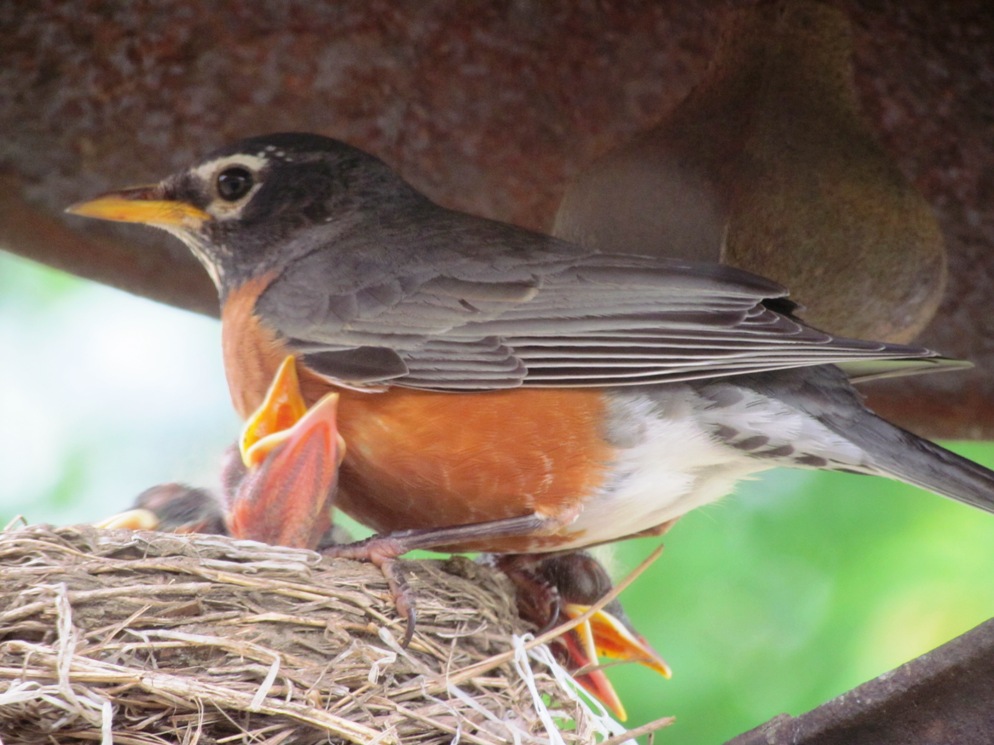
Robins, not bats, in the belfry
Brambleberry was the home of Sara Clair, Chris's great aunt, before we moved in and opened it up as a bed and breakfast.
One of Aunt Sara's trademarks when she and Uncle Leland ran the farm was to ring the dinner bell for lunch. Of course they called it dinner back then and it was quite a mid-day spread. The bell is solid iron and you could hear it echoing throughout our valley when it rang.
We've kept the bell as a tribute to Aunt Sara and have it mounted on a tall post near our back kitchen door. This year a robin decided that the top of the post -- right under the bell -- was a good place to build a nest.
We love robins, but we fight with them every spring to prevent them from building nests in hanging plants. We also have to take down our signature brambleberry wreath that welcomes guests by the front door because the birds insist that it would be a perfect place to build a nest.
So we watched as the robins built the nest under the bell. This past week we noticed that the eggs had hatched and it's a crowded nest -- four chicks! They are surely ugly chicks for the first few weeks and they keep mother robin quite busy bringing worms and other food for the hungry mouths.
We will honor the sanctuary of the robin and watch as the birds get old enough to fly away.
Perhaps when the last one leaves the nest we will ring the bell in its honor!
Tuesday, April 2, 2013
The sweet season of syrup-making
![]() |
| Pure maple syrup |
There's gold in those trees -- the maple trees, that is. This is the time of year in Wisconsin and Minnesota where maple sap is collected from the trees and turned into delicious, liquid-gold syrup.
We make syrup in an old-fashioned way. We have about 30 trees with specially designed bags hung on each tap. We collect the sap once or twice a day, depending on how heavy the run is.
After a terrible season last year when the weather warmed too quickly, so far this spring the weather has been great for sap flow. The best conditions are for temperatures above 40 degrees during the day and dipping below freezing at night. This moves the sap from the roots into the trunk and provides the constant drip.
Most of our trees are not sugar maples, but you can make syrup from any maple tree. The ratio of sap to syrup in a sugar maple is 40 to 1, but it's closer to 50 to 1 with our maples.
Over one recent weekend we collected more than 50 gallons of sap. After it was cooked down, we ended up with about 156 ounces of syrup -- a gallon and three cups -- that was filtered and stored in canning jars.
The primary cooking down -- a process that evaporates the water -- takes place in our garage over a wood-fired stove. The stove's flat surface holds two roasting pans, which we fill with sap and continue to refill as it evaporates. When the sap has thickened enough, it is brought inside the house for the finishing process.
![]() |
| The sap being boiled down |
It's a long and tedious process, but we enjoy making such a delicious product from our land. Guests who stay at our inn -- Brambleberry Bed and Breakfast -- get to enjoy the fruits of our labors with breakfast.
We also have additional syrup available for purchase when we have a surplus. That looks like it will happen this year.
Sunday, February 17, 2013
A trio to start the lambing season
![]() |
| Mary and her three triplet lambs. |
Mary, one of our original ewes, had a set of triplets on Feb. 13.
We had intended to wait longer this year before having lambs due, but like other years an amorous and determined ram decided last fall that fences were no obstacle for him getting his job done.
He apparently did it well in the one day that he escaped because we've also had twins and a single birth in the past four days, with several more looking ready to birth as well.
Saturday morning our Valentine weekend guests were lucky enough to witness a live birth.
So far all of the lambs have been boys, which is OK, since these are all crossbred lambs and not animals that we would keep for breeding stock. We would prefer that our purebred sheep will have ewes.
The weather has been cold, with overnight lows close to zero, but the lambs so far are doing fine. We hand-strip some mother's milk and tube-feed our lambs just to make sure they get some colostrum which is essential to their survival.
Of course it also means that we're not getting much sleep, but that's part and parcel with lambing season.
Sunday, December 9, 2012
The first snowfall of the season
![]() |
| The view from Brambleberry's front porch. |
Not only will it add to the beauty of the holiday season, but more importantly we need lots of snow this winter to help us break the drought.
We're supposed to receive up to 8 inches today and the photo (with the weird color spot in the middle -- not sure what that is) was taken in the morning while the snow was falling.
We spent yesterday doing some final preparations for the snow, but there is still not enough wood for the winter, so that task will continue. The sheep have been put into their winter quarters, which means breeding season is over.
There's always lots of winter recreation to enjoy around here, as guests can use our snowshoes and sledding equipment. There are nearby cross country ski trails and snowmobile trails. Last year was pretty much a snow-less winter and no one liked it.
Let it snow, let it snow, let it snow!
Sunday, October 14, 2012
A challenging year of farming
It would be an understatement if we said that the weather has created a challenge for our farming this year.
The drought has created challenges and concerns that a normal year would not bring -- if there is such a thing as a normal year when you engage in farming.
As we write this blog on Oct. 14, it is raining for the second day and so far we've received 1.35 inches. While the growing season is over (we had a killing frost the third week of September), we need the moisture to start replenishing the ground and to help our perennials and young fruit trees.
There's a saying "no matter how bad you have it, there's always someone who has it worse." That certainly is our case as we had some timely rain in early June that allowed us to harvest a nice first cutting and second cutting of hay. The third cutting was much lighter, however, and the fourth cutting was non-existent because we haven't had much rain since early August.
Because it's been so dry this summer and because we were unable to get some fencing done, the pastures we had dried up and we've been feeding hay to our sheep and cows nearly the whole summer. We have concerns about having enough hay to get through the winter. Buying it would be very expensive as small square bales like the ones we put up are going for $5 to $8 each. That's crazy.
We did send this year's slaughter lambs to market last week and our pigs will go to the butcher next week. That cuts down on our chores and replenishes our freezer. We've got our young rams in with the flocks and we hope they are up to the task.
Now we've got to get our winter's wood supply laid up before the snow flies.
The drought has created challenges and concerns that a normal year would not bring -- if there is such a thing as a normal year when you engage in farming.
As we write this blog on Oct. 14, it is raining for the second day and so far we've received 1.35 inches. While the growing season is over (we had a killing frost the third week of September), we need the moisture to start replenishing the ground and to help our perennials and young fruit trees.
There's a saying "no matter how bad you have it, there's always someone who has it worse." That certainly is our case as we had some timely rain in early June that allowed us to harvest a nice first cutting and second cutting of hay. The third cutting was much lighter, however, and the fourth cutting was non-existent because we haven't had much rain since early August.
Because it's been so dry this summer and because we were unable to get some fencing done, the pastures we had dried up and we've been feeding hay to our sheep and cows nearly the whole summer. We have concerns about having enough hay to get through the winter. Buying it would be very expensive as small square bales like the ones we put up are going for $5 to $8 each. That's crazy.
We did send this year's slaughter lambs to market last week and our pigs will go to the butcher next week. That cuts down on our chores and replenishes our freezer. We've got our young rams in with the flocks and we hope they are up to the task.
Now we've got to get our winter's wood supply laid up before the snow flies.
Monday, September 3, 2012
Harvest dinners well underway
Our harvest dinners at Brambleberry Bed and Breakfast are well underway.
Every Saturday through the end of October we feature farm-to-fork dinners that literally gets guests in touch with their food source. Between 90 to 100 percent of the organic fruits, vegetables and herbs served are grown onsite.
The hot and dry summer has forced us to be a little creative with the vegetables we offer from our garden. Some of our vegetables failed this year and others came in less than expected, but that's why we grow a big garden.
Every Saturday through the end of October we feature farm-to-fork dinners that literally gets guests in touch with their food source. Between 90 to 100 percent of the organic fruits, vegetables and herbs served are grown onsite.
The hot and dry summer has forced us to be a little creative with the vegetables we offer from our garden. Some of our vegetables failed this year and others came in less than expected, but that's why we grow a big garden.
All natural homegrown pork is produced onsite with zero miles. Beef and chicken come from Arcadia, 25 miles away. We try to predict what will be ready in the garden for these meals but reserve the right to make vegetable substitutions if necessary.
All dinners include homemade bread and a glass of wine. Wisconsin wines served at our dinner come from Tenba Ridge Winery, Elmaro Vineyards, Wollersheim Winery and Brambleberry's own wine vat!
Overnight guests can join us on Saturdays for our farm to fork five-course harvest dinners for $30 to $35 per person.
Sunday, July 15, 2012
Calving season is over
Our third Scottish Highland cow that has been looking very pregnant for the past two months finally delivered a heifer calf, but it was not without some challenges.
We were thankful the cow managed to get through a recent 100-plus degree streak without calving. But when she had the calf, it dropped in an awkward position on top of its head and was not moving.
Sherry climbed into the pen and kept a close eye on the mother -- Highlands do not take kindly to perceptions that you are messing with their calves. Sherry was able to get close enough to the calf to roll it over and she started moving. Yes, she. Two of our three calves born this year were heifers.
Heather has now joined the herd.
Soon we will be removing the bull calf who was born in March because he will become a steer and be raised for meat. He will join two other beef calves we bought this spring and will be the start of our mainly grass-fed beef operation.
We were thankful the cow managed to get through a recent 100-plus degree streak without calving. But when she had the calf, it dropped in an awkward position on top of its head and was not moving.
Sherry climbed into the pen and kept a close eye on the mother -- Highlands do not take kindly to perceptions that you are messing with their calves. Sherry was able to get close enough to the calf to roll it over and she started moving. Yes, she. Two of our three calves born this year were heifers.
Heather has now joined the herd.
Soon we will be removing the bull calf who was born in March because he will become a steer and be raised for meat. He will join two other beef calves we bought this spring and will be the start of our mainly grass-fed beef operation.
Sunday, July 1, 2012
A surprise but welcome arrival
We have a new member of the Brambleberry farm family and she came as a surprise.
Flora, a snow-white Scottish Highland heifer calf, was born last week. And we didn't know that her mother was pregnant!
Deidre gave birth a year ago to our young bull Gavin and all the cows were with a bull last summer and fall on another farm before we bought them. But she certainly didn't look as fat and large as Mulberry, our third Highland cow who has looked ready to calve for about a month now.
We spotted the newborn calf during our nightly feeding but wondered why Mulberry was not paying any attention to her. That concerned us because calves must have their mother's milk within a few hours of birth to ensure their survival. We thought it odd that Deidre seemed to be more interested in the calf.
Finally, logic prevailed and we realized that Deidre had also been with the bull last year. It also made more sense because Flora's brother Gavin also was very white when he was young. His coat has started to darken but it's still the color of cream with shades of red.
Flora is doing well and we're happy to have a heifer for future herd expansion. She joins Sir Loin, a bull calf born on St. Patrick's Day.
Meanwhile, we're still waiting on Mulberry. Perhaps we'll have something else to celebrate this July 4!
Flora, a snow-white Scottish Highland heifer calf, was born last week. And we didn't know that her mother was pregnant!
Deidre gave birth a year ago to our young bull Gavin and all the cows were with a bull last summer and fall on another farm before we bought them. But she certainly didn't look as fat and large as Mulberry, our third Highland cow who has looked ready to calve for about a month now.
We spotted the newborn calf during our nightly feeding but wondered why Mulberry was not paying any attention to her. That concerned us because calves must have their mother's milk within a few hours of birth to ensure their survival. We thought it odd that Deidre seemed to be more interested in the calf.
Finally, logic prevailed and we realized that Deidre had also been with the bull last year. It also made more sense because Flora's brother Gavin also was very white when he was young. His coat has started to darken but it's still the color of cream with shades of red.
Flora is doing well and we're happy to have a heifer for future herd expansion. She joins Sir Loin, a bull calf born on St. Patrick's Day.
Meanwhile, we're still waiting on Mulberry. Perhaps we'll have something else to celebrate this July 4!
Sunday, June 24, 2012
Birds busy nesting
| These baby robins want food all of the time. |
Many of our avian friends are visible just by sitting on our porches. The barn swallows nest in the former dairy barn and are our natural mosquito predators. You can watch them dip and dive from morning to night catching bugs for their young.
We also have lots of robins. This spring a robin built a nest on a decorative basket we hung on the wall of our garage with hopes that's exactly what would happen. It's a non-stop battle to try to keep the robins and other birds from nesting right near our porch doors.
There were actually three birds in the nest -- you can see the tips of the yellow beak of the third bird near the adult robin. Without feathers the baby birds look more like prehistoric creatures. But they wait with open mouths as the parent comes in with bits of regurgitated worms and other food to feed them. It's an endless job that doesn't stop until the birds are big enough to fly away.
And then the circle of life continues.
Sunday, June 10, 2012
Saturday, June 9, 2012
Baling hay brings challenges
![]() |
| Some of the 1,500 bales of first cop hay stacked in the barn. |
That was certainly the case this year with our first crop of hay. Most farmers get between three and four cuttings of hay, which grows back in between harvests -- just like your lawn.
Chris had taken the week of Memorial Day as vacation with the intent to bale hay, but cool weather and equipment issues preventing the hay from being cut until the first weekend of June. The hay baler needed repairs, which was accomplished.
![]() |
| A new chain was needed to fix the elevator. |
Chris helped unload hay when he got home from work and two remaining hay wagons are safely tucked inside a shed. When those wagons are unloaded, there will be more than 1,500 bales of hay in the barn -- feed for the sheep and cows in the fall and winter.
But if we don't get rain soon, we will be feeding it year-round. The pastures are drying up and that means our second cutting of hay might be a lot less. But that's just another challenge in farming!
Sunday, May 13, 2012
Shaven and shorn sheep
Another sure sign of spring at Brambleberry is sheep shearing.
Twenty-five of our ewes, two rams and our wether are now sporting new haircuts as their thick layers of wool have been cut off.
Some sheep farmers have their flocks sheared before lambing, but we've always waited until after every ewe has lambed and the weather has warmed up to have our flock sheared. We hire a local Amish farmer who is still learning the skill but does an excellent job in just a few hours.
It's always an unsettling day for the flock, as the ewes are separated from their lambs for a few hours before everyone is sheared and they can reunite. The lambs are not sheared because their fleece is not yet thick enough. The older girls who have been through the process before handle it better than the new ewes who are being clipped for the first time.
It's always amazing how thick their coats are after a year of growth and there's always a lot more room in our barn after the sheep are downsized. They look more like goats until their wool starts to grow back.
We don't make any money selling the wool since our sheep do not have the high-quality fiber sought by spinners. By the time we pay for the shearing and for the freight to ship our wool, we lose money. We wish there was more of a market for wool, but we raise our sheep for meat and for breeding stock.
But our flock is now ready for summer!
Twenty-five of our ewes, two rams and our wether are now sporting new haircuts as their thick layers of wool have been cut off.
Some sheep farmers have their flocks sheared before lambing, but we've always waited until after every ewe has lambed and the weather has warmed up to have our flock sheared. We hire a local Amish farmer who is still learning the skill but does an excellent job in just a few hours.
It's always an unsettling day for the flock, as the ewes are separated from their lambs for a few hours before everyone is sheared and they can reunite. The lambs are not sheared because their fleece is not yet thick enough. The older girls who have been through the process before handle it better than the new ewes who are being clipped for the first time.
It's always amazing how thick their coats are after a year of growth and there's always a lot more room in our barn after the sheep are downsized. They look more like goats until their wool starts to grow back.
We don't make any money selling the wool since our sheep do not have the high-quality fiber sought by spinners. By the time we pay for the shearing and for the freight to ship our wool, we lose money. We wish there was more of a market for wool, but we raise our sheep for meat and for breeding stock.
But our flock is now ready for summer!
Saturday, May 5, 2012
The hunt for morels
I'm not a mycologist but I really enjoy morel mushrooms. These annual fungi, which need a combination of moisture and warm weather to sprout, are hunted by many enthusiasts this time of year in Wisconsin.
Morels taste earthy, nutty and a little goes a long way, but they are so, so good. I usually just saute them with butter and a little garlic powder. They are also fantastic on the grill.
With more than 500 acres of family farm to explore at Brambleberry Farms, there are plenty of places to hunt. The challenge is to find the time when the weather conditions are right. With a very early spring this year followed by cool weather, it was anyone's guess as to when the mushrooms would be out.
Recently we've had plenty of rain and temperatures in the upper 70s, so I figured the time would be right. Accompanied by our dog Nessie and the farm dog Lucky, I headed into the woods.
I am by no means an expert morel hunter, but I've had the best luck finding them in the vicinity of dead elm trees and sometimes apple trees. Our woods are mainly a mixture of oak, birch, hickory, ash and elm, so it's a matter of spotting the trees and diligently searching the area.
What makes morel hunting so maddening is that the tree where you found the mother lode the year before may not have anything this year. It's a fickle fungus. Many times I've come home empty-handed but always enjoying the time spent in the woods regardless.
I should caution anyone eating wild mushrooms to make sure they are safe. As you can see by the photo below, there are many mushrooms in the woods and some of them are deadly poisonous.
This year I got lucky. I found about eight morels in the vicinity of two small dead elms. Then I found a veritable feast -- a couple dozen near a tree that hardly looked dead, but was apparently the perfect place.
There's nothing quite like tasting the first fresh morel of the year. Makes me want to go out and find some more.
-- Chris Hardie
![]() |
| The bounty of the hunt. |
With more than 500 acres of family farm to explore at Brambleberry Farms, there are plenty of places to hunt. The challenge is to find the time when the weather conditions are right. With a very early spring this year followed by cool weather, it was anyone's guess as to when the mushrooms would be out.
Recently we've had plenty of rain and temperatures in the upper 70s, so I figured the time would be right. Accompanied by our dog Nessie and the farm dog Lucky, I headed into the woods.
I am by no means an expert morel hunter, but I've had the best luck finding them in the vicinity of dead elm trees and sometimes apple trees. Our woods are mainly a mixture of oak, birch, hickory, ash and elm, so it's a matter of spotting the trees and diligently searching the area.
What makes morel hunting so maddening is that the tree where you found the mother lode the year before may not have anything this year. It's a fickle fungus. Many times I've come home empty-handed but always enjoying the time spent in the woods regardless.
I should caution anyone eating wild mushrooms to make sure they are safe. As you can see by the photo below, there are many mushrooms in the woods and some of them are deadly poisonous.
This year I got lucky. I found about eight morels in the vicinity of two small dead elms. Then I found a veritable feast -- a couple dozen near a tree that hardly looked dead, but was apparently the perfect place.
There's nothing quite like tasting the first fresh morel of the year. Makes me want to go out and find some more.
-- Chris Hardie
![]() |
| The first morel of the season. |
![]() |
| Look carefully -- it's a morel bonanza! |
![]() |
| Just because you find mushrooms under a dead elm, it doesn't mean they are morels! Some mushrooms are deadly poisonous. |
Saturday, April 28, 2012
The strange spring of 2012
| Asparagus on April 1. |
This spring will certainly go down as one of the weirdest weather seasons we've ever experienced. The maple syrup season ended early when temperatures the second week of March climbed into the upper 70s and never cooled down at night.
This caused some of our annual crops to start early. The picture of the rhubarb emerging was from March 18 and the picture of the asparagus was from April 1. Yes -- we're not fooling -- we had fresh asparagus from our garden the first week of April.
Of course the old saying about Wisconsin weather -- if you don't like the weather we're having, wait a minute -- proved to be true as a cold snap in mid-April brought us temperatures in the low 20s overnight for almost a week. We tried to cover our blossoming apple trees, but it was futile.
The past few nights we've been covering our strawberry plants, which are already blossoming.
Only time will tell if we will have any apple crop this year, but last weekend the garden was tilled and some of the early vegetables -- like potatoes, leeks, carrots, parsnips, peas and beets -- are in the ground.
Our first crop of hay will surely be earlier this year as well, but we need some warm temperatures and no freezing overnight so that it can take off.
| Rhubarb on March 18. |
Sunday, April 22, 2012
Rhythm of life not always easy
A few minutes into the most miraculous day of the year, my wife, Sherry,
delivered a set of breech birth lamb twins.
It was Easter morning shortly after midnight. The ewe had gone into labor a few hours earlier but there was no progress. We suspected trouble. I held the ewe down and Sherry pulled out a ram lamb. A tiny ewe lamb followed.
New life.
There’s a seasonal rhythm to life that is keenly felt on the farm. No season reflects that more than spring, with green shoots bursting forth, crops and gardens being planted. It’s also the season for lambing.
But rhythm of life is far from perfect or pretty. Three days after the Easter morning birth it was clear that the ram lamb was not going to survive. We had fed him with a tube, but his serious injuries from a difficult birth prevented him from even getting up to nurse, which his sister was doing.
The lamb’s eyes were glazed and his skin was cold. He was suffering.
I gathered him up and carried him in a cardboard box away from the barn. I dug a hole in the cold, sandy earth and gently laid him down. I completed my least-favorite job as a shepherd when I pulled the trigger. No more suffering.
My commute to work that morning was somber. I reflected in the silence.
Life and death. Lots of questions and not many answers.
I thought about the emotional funeral a few days earlier in Winona, Minn., where more than 150 people showed up to say goodbye to Baby Angel, the unidentified newborn girl found in a canvas bag floating in the Mississippi River last September. We may never know how Angel got there.
I thought about Sara Hougom of La Crosse, whose life was taken by a bullet March 26. Police are still looking for the killer and why this young woman was slain.
Life and death. Lots of questions and not many answers.
I once discovered that the word sheep or shepherd is mentioned 247 times in the Bible. Sheep have been a part of our lives for some 10,000 years and were a means of living for our ancestors. It’s understandable that such an important book as the Bible would use sheep to illustrate the work of our Lord — it was language people could relate to.
Sherry and I are shepherds. The sheep respond to our voice, allow us to give them care and rely on us for their food and water. The sheep follow us.
Every day, we tend to our flock. I will never tire of watching the lambs jump around. Holding a lamb in your arms is a wonderful stress reliever.
But there’s a lot more to shepherding than romantic notions of green pastures and white, fluffy sheep. Our sheep have thick wool fleeces that are not really pretty this time of year. Bits of manure cling to their rear legs. They don’t smell very nice.
Sometimes, too, it’s hard to not focus on the manure in our imperfect world. We feel surrounded and overwhelmed at times with the stench of injustice, suffering and all that is wrong. Some days it just seems easier to put our head down and follow the flock rather than trying to be a shepherd.
Later that morning, Sherry called to say another ewe was in labor. News then arrived that we had a perfectly healthy set of twin lambs.
My heart lifted as I rejoiced with the new life. I found the energy to be a shepherd again.
There will always be more questions than answers.
But the rhythm of life continues.
It was Easter morning shortly after midnight. The ewe had gone into labor a few hours earlier but there was no progress. We suspected trouble. I held the ewe down and Sherry pulled out a ram lamb. A tiny ewe lamb followed.
New life.
There’s a seasonal rhythm to life that is keenly felt on the farm. No season reflects that more than spring, with green shoots bursting forth, crops and gardens being planted. It’s also the season for lambing.
But rhythm of life is far from perfect or pretty. Three days after the Easter morning birth it was clear that the ram lamb was not going to survive. We had fed him with a tube, but his serious injuries from a difficult birth prevented him from even getting up to nurse, which his sister was doing.
The lamb’s eyes were glazed and his skin was cold. He was suffering.
I gathered him up and carried him in a cardboard box away from the barn. I dug a hole in the cold, sandy earth and gently laid him down. I completed my least-favorite job as a shepherd when I pulled the trigger. No more suffering.
My commute to work that morning was somber. I reflected in the silence.
Life and death. Lots of questions and not many answers.
I thought about the emotional funeral a few days earlier in Winona, Minn., where more than 150 people showed up to say goodbye to Baby Angel, the unidentified newborn girl found in a canvas bag floating in the Mississippi River last September. We may never know how Angel got there.
I thought about Sara Hougom of La Crosse, whose life was taken by a bullet March 26. Police are still looking for the killer and why this young woman was slain.
Life and death. Lots of questions and not many answers.
I once discovered that the word sheep or shepherd is mentioned 247 times in the Bible. Sheep have been a part of our lives for some 10,000 years and were a means of living for our ancestors. It’s understandable that such an important book as the Bible would use sheep to illustrate the work of our Lord — it was language people could relate to.
Sherry and I are shepherds. The sheep respond to our voice, allow us to give them care and rely on us for their food and water. The sheep follow us.
Every day, we tend to our flock. I will never tire of watching the lambs jump around. Holding a lamb in your arms is a wonderful stress reliever.
But there’s a lot more to shepherding than romantic notions of green pastures and white, fluffy sheep. Our sheep have thick wool fleeces that are not really pretty this time of year. Bits of manure cling to their rear legs. They don’t smell very nice.
Sometimes, too, it’s hard to not focus on the manure in our imperfect world. We feel surrounded and overwhelmed at times with the stench of injustice, suffering and all that is wrong. Some days it just seems easier to put our head down and follow the flock rather than trying to be a shepherd.
Later that morning, Sherry called to say another ewe was in labor. News then arrived that we had a perfectly healthy set of twin lambs.
My heart lifted as I rejoiced with the new life. I found the energy to be a shepherd again.
There will always be more questions than answers.
But the rhythm of life continues.
Subscribe to:
Posts (Atom)